
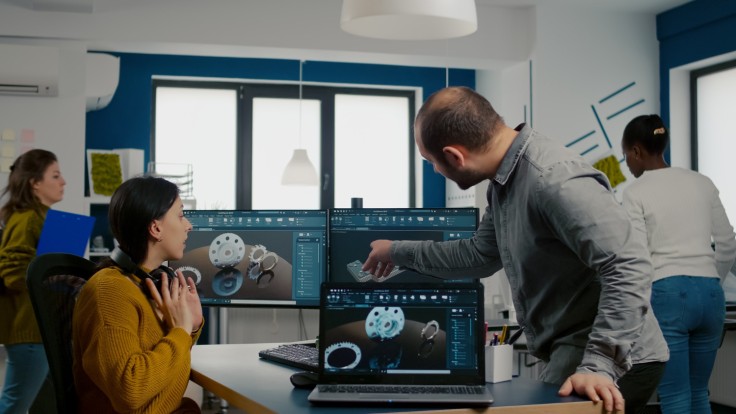
In recent years, the way companies design, test, and develop products has completely changed. What once required multiple physical prototypes, lengthy correction processes, and significantly slower workflows can now be handled digitally, thanks to engineering CAD tools. Today, Dassault Systèmes is one of the most recognized companies in this field, particularly for the technological impact it has on industries where precision and efficiency are critical.
CAD, or computer-aided design, is no longer a technology exclusive to large manufacturers or complex industrial sectors. It is now part of the day-to-day operations of companies of all sizes across a wide range of industries, including architecture, mechanical engineering, parts manufacturing, electronics, and consumer product development.
The Need to Reduce Errors and Optimize Processes
Its growth stems from the growing need to reduce errors before reaching the production stage. Detecting a problem after the product has already been manufactured can result in significant financial losses, as well as delays and wasted materials. These types of tools allow teams to view designs in detail, make modifications in real time, and analyze how each component will function even before the first prototype is built.
This has also changed the dynamics of collaboration between teams. It is now common for designers, engineers, and production managers to work collaboratively on the same digital model. This integration enables faster decision-making and helps avoid problems that arise when each department works in isolation.
Another key aspect is simulation. Many modern CAD platforms integrate modeling and simulation software that allows teams to test strength, thermal behavior, motion, or structural performance without the need to physically build every version of the product. In industries where safety is a priority, such as the automotive or aerospace sectors, this type of analysis has become virtually indispensable.
The Impact of CAD on Manufacturing and Automation
Furthermore, advances in digital manufacturing and automation have made CAD even more relevant. Today, digital models are used not only for design but also to integrate with manufacturing processes, 3D printing, and smart production systems. This helps reduce lead times and creates a much smoother transition from initial design to final manufacturing.
The adoption of these tools is also linked to changing consumer expectations. Today, companies need to launch new products faster, adapt quickly to trends, and respond to increasingly specific demands. In this context, working with manual or slow processes is practically unfeasible.
For example, in the development of electronic devices, update cycles are becoming increasingly shorter. A similar shift is happening in the automotive industry, where new technologies related to energy efficiency, connectivity, or electric mobility are constantly emerging. In both cases, having engineering CAD tools allows for accelerating stages without compromising quality.

How Different Industries Are Adopting CAD Solutions
The construction industry has also begun to rely increasingly on these types of technologies. The ability to create accurate models and detect conflicts before starting a project helps optimize resources and improve overall project planning. This is particularly useful in complex projects involving multiple teams and suppliers.
Even small and medium-sized businesses are adopting CAD solutions to improve their internal processes. A few years ago, this type of software was often an expensive or difficult-to-implement tool. However, technological advancements and access to more flexible platforms have made it possible for many companies today to utilize these systems without requiring massive investments.
Added to this is the growing importance of data. Modern CAD platforms are much more than simple technical drawing tools. They are part of broader digital transformation ecosystems that connect design, simulation, analysis, and information management, enabling data-driven decision-making and continuous process improvement.
The Future of Digital Engineering
According to information published by Forbes, digital transformation remains a top priority for industrial and technology companies across various markets. Beyond the technology itself, one of the most visible changes concerns the way teams work. Product development has become much more dynamic, collaborative, and connected. Timelines have shortened, processes have been integrated, and adaptability has become a key factor.
All signs suggest this trend will continue to grow in the coming years. As companies seek more agile processes, more personalized products, and more efficient production systems, CAD tools will become increasingly indispensable.


